
- average 2-bedroom rent, Montreal area, 2025 (CMHC)
- C$1,346
- vacancy rate, Montreal area, 2025 (CMHC)
- 2.9%
- monthly budget for one person, our estimate
- C$2,472
On this page
One person renting a new one-bedroom in Montreal needs about C$2,470 a month (about US$1,730) before going out, a couple about C$2,920 and a family of four in a two-bedroom about C$4,010. Rent is the biggest line and it climbed fast: the national housing agency CMHC puts the Montreal vacancy rate at 2.9% for 2025. Below, each cost with its source, then the sums. Dollar conversions use the Bank of Canada rate of C$1.4325 per US dollar on November 20, 2026.
Monthly cost of living in Montreal for one person, a couple and a family
These budgets are our own calculation, not an official statistic. They assume a new lease at asking rents, a transit pass instead of a car, and groceries cooked at home. They leave out restaurants, trips and savings, so add what you actually spend on those.
| Monthly cost in C$ | One person | Couple | Family of four |
|---|---|---|---|
| Rent | 1,722 | 1,722 | 2,251 |
| Groceries | 400 | 700 | 1,000 |
| Transit passes | 110 | 220 | 220 |
| Electricity | 95 | 95 | 130 |
| Internet | 66 | 66 | 66 |
| Phones | 49 | 90 | 160 |
| Other basics | 30 | 30 | 40 |
| Childcare, one child | 0 | 0 | 209 |
| Total | 2,472 | 2,923 | 4,010 |
In US dollars that is about US$1,726 for one person, US$2,041 for a couple and US$2,799 for a family. The rents come from asking prices, not from CMHC averages, because asking prices are what a newcomer pays. The family column counts one child in subsidized childcare and the family's two-bedroom, and the electricity lines assume an electrically heated apartment in winter.
Rent in Montreal: averages, asking prices and why new leases cost more
The CMHC rental market report for 2025, published on December 11, 2025, gives an average two-bedroom of C$1,346 in purpose-built rental buildings in the Montreal area, up 7.2% in a year, the fastest rise the agency describes. The vacancy rate was 2.9%, up from 2.1% in 2024 and inside the 2.5% to 4.0% band that CMHC calls balanced in its mid-2026 update. Rental condos are pricier at C$1,826 for a two-bedroom, with a vacancy rate of 2.1%.
An average hides a split between old and new leases. CMHC measured a rent increase of 17.2% on units that changed tenants in 2025 (18.7% in 2024), against 6.0% on units where the tenant stayed. A tenant who has lived in the same flat for years pays much less than you will on a new lease, so averages understate the price of arriving in Montreal today.
For asking rents, the one-bedroom figure we use is C$1,722 a month for the city (from the Rentals.ca national rent report, a listings index) and C$2,251 for a two-bedroom. The rental site liv.rent measured a one-bedroom at C$1,693 in 2025, with downtown the most expensive at C$1,890 and Hochelaga-Maisonneuve the cheapest at C$1,462. Neighborhoods such as the Plateau and downtown sit at the top of that range.
Rent increases on renewal are regulated. Quebec's rental board, the Tribunal administratif du logement, sets a base percentage of 3.1% for notices sent from January 1, 2026 (4.5% in 2025), with adjustments for services and major works. It is a base for the calculation, not an automatic ceiling. A tenant has one month to accept or refuse, and the landlord then has one month to go to the board.
Groceries and eating out in Montreal
Plan on C$340 to C$430 a month for one person and C$900 to C$1,100 for a family of four, a range from a Concordia University estimate relayed by a moving site, so treat it as a ballpark. The contributor prices on Numbeo, read on November 21, 2026, give a sense of the shelf: milk 1 L C$3.12, a dozen eggs C$5.00, chicken C$15.77 per kg and rice C$4.24 per kg.
Basic groceries carry no sales tax in Quebec, restaurant meals do. The 5% GST and 9.975% QST add up to 14.975% on a restaurant bill, and a tip of around 15% comes on top. A cheap restaurant meal costs about C$25 according to Numbeo, a mid-range dinner for two C$100, a pint C$9 and a cappuccino C$5.50, while a gym membership averages C$64 a month and a cinema ticket C$16. Those lines sit outside our budgets, so a couple eating twice a week at cheap restaurants adds about C$430 a month (our sum: 2 people, 2 meals, 4.3 weeks, C$25). Our restaurant guide lists dated menu prices if you want to eat out on a budget, and bagels or a poutine fill a day for less than C$20.
Transit and transport costs in Montreal
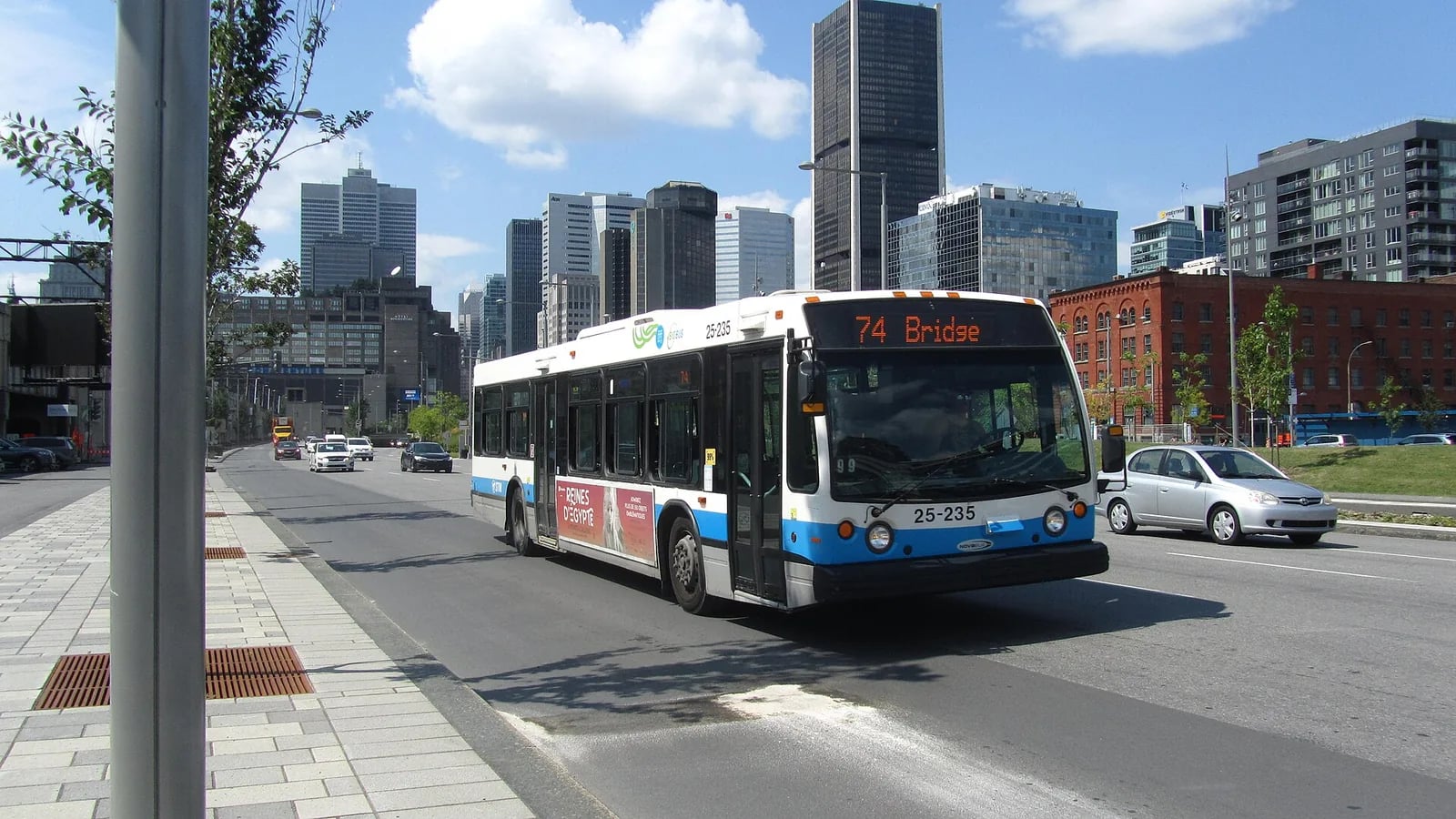
The monthly pass for the Montreal zone costs C$110 since July 1, 2026, after a C$5.50 rise announced by the Quebec government. Single tickets (C$3.75) and 10-trip packs (C$35) did not change. The getting around guide explains the zones and the OPUS card, and the monthly price is the figure to put in your budget if you live near a metro line.
Owning a car costs far more than the pass once you add insurance, parking and winter tires. Numbeo lists petrol at about C$1.89 per liter. Quebec car insurance combines a public part paid through your licence and a private policy whose premium depends on your record, so ask for quotes before you decide to buy.
Electricity, internet and phone bills in Montreal
Hydro-Québec raised residential rates by 3% on April 1, 2026, according to the Régie de l'énergie, Quebec's energy regulator. The grid in the regulator's December 2025 decision for the standard residential rate D has three parts: 6.905 cents per kWh for the first 40 kWh each day, 10.652 cents above that, and a flat 46.154 cents per day for access to the network, all before tax. Check the current grid on Hydro-Québec's site before you rely on the cents.
On that grid, a month of 1,000 kWh costs about C$83 before tax, or about C$95 with taxes (our sum, 30 days). A cold month with 1,500 kWh costs about C$129 before tax, or about C$148 with taxes, which is why a heated apartment costs more in January than in May. Most Montreal apartments are heated with electricity, so the winter bill matters more than the annual average.
For internet and mobile, Numbeo shows about C$66 and C$49 a month, based on contributors, and there is no official figure. If you are arriving soon, compare a Canada eSIM with a local prepaid plan for your first weeks.
Childcare costs in Quebec: C$9.65 a day, if you find a place
Subsidized childcare (CPE, subsidized private daycares and home-based care) costs C$9.65 per day in 2026 according to the Quebec government, indexed each January 1. That is about C$209 a month per child at roughly 21.7 weekdays, our sum. Earlier figures of C$9.10 or C$9.35 are out of date. The difficulty is availability: the waiting lists are long, and parents register for a place as early as possible.
Without a subsidy, private daycares set their own price. Numbeo reports a full-time private preschool at about C$723 a month, with a wide range from C$200 to C$1,200. Quebec offers a provincial tax credit and the federal government a deduction, both based on income.
Salary needed to live in Montreal: a rule of thumb
Nobody publishes an official figure, so use a rule instead. Housing agencies often suggest keeping rent under 30% of gross income. For a C$1,722 one-bedroom that means a gross monthly income of about C$5,740, or about C$68,900 a year (about US$48,100). For a C$2,251 two-bedroom it is about C$90,000 a year. These are our sums from the 30% rule, and they ignore savings and debt.
The minimum wage in Quebec is C$16.60 an hour since May 1, 2026, and C$13.30 for employees who receive tips, according to the labor standards board CNESST. At 35 hours a week that is about C$2,518 gross a month, or about C$30,200 a year (our sum), which is less than the C$2,472 budget above once income tax is taken out. A single person on the minimum wage therefore needs a roommate or an older lease, and that is why the split between old and new leases matters so much when you plan the move.
Quebec income tax and sales tax in the budget
Quebec has its own income tax on top of federal tax, with four brackets of 14%, 19%, 24% and 25.75%. For 2026 the government indexed the system by 2.05% and kept the rates. The bracket limits move each year, so use Revenu Québec's calculator for your net pay. Sales tax of 14.975% applies to most purchases, as our money guide explains.
Montreal vs Toronto cost of living: where the gap is
Rent is the gap. For a two-bedroom, CMHC measured C$1,346 in the Montreal area against C$2,034 in the Toronto area for 2025, about C$690 more a month in Toronto. Rentals.ca asking prices for one-bedrooms pointed the same way at C$1,722 in Montreal against C$2,229 in Toronto, a listings index rather than signed leases. Groceries and restaurants cost about the same, and the sales tax is higher in Quebec (14.975% against 13% in Ontario). Our Montreal vs Toronto comparison goes through jobs, language and winters as well.