- per US$1, Bank of Canada, Nov. 20, 2026
- C$1.4325
- GST plus QST added to most prices
- 14.975%
- usual tip, calculated before taxes
- 15%
On this page
On November 20, 2026 the Bank of Canada's daily average rate was C$1.4325 for US$1, which puts C$100 at about US$69.81. In Montreal you pay in Canadian dollars, almost always by card, with 14.975% sales tax added at the till and a tip of about 15% in restaurants. Below are the bills and coins, card and ATM fees, the tax and tipping rules, and a realistic daily budget built from prices we checked in November 2026.
Canadian dollar exchange rate for a Montreal trip
The Bank of Canada publishes a daily average rate on business days. It is a reference rate, not the rate your bank, your card or an exchange office will give you, but it shows where the market stands.
| Observation date | US$1 in C$ | C$100 in US$ |
|---|---|---|
| November 20, 2026 | C$1.4325 | US$69.81 |
| November 19, 2026 | C$1.4317 | US$69.85 |
| November 18, 2026 | C$1.4326 | US$69.80 |
On the same day the Bank of Canada's rate was C$1.5727 for 1 euro and C$1.8769 for 1 pound sterling. The rate moves daily, so treat these numbers as a snapshot and look up the current one on the Bank of Canada site or in your banking app before you convert a large amount.
To turn Montreal prices into US dollars, here is the same rate applied to costs we published on this site:
| Price | At C$1.4325 | What it buys |
|---|---|---|
| C$3.75 | US$2.62 | One STM metro or bus ride |
| C$11.25 | US$7.85 | 24-hour transit pass |
| C$25.50 | US$17.80 | Biodome adult ticket |
| C$100 | US$69.81 | A restaurant bill before tax |
If you are comparing destinations, the exchange rate is only half of the story: Quebec taxes are added on top of shelf prices, which the sales tax section below works through. For a list of what the transit pass covers, see our guide to getting around Montreal.
Canadian bills and coins: loonie, toonie and no penny
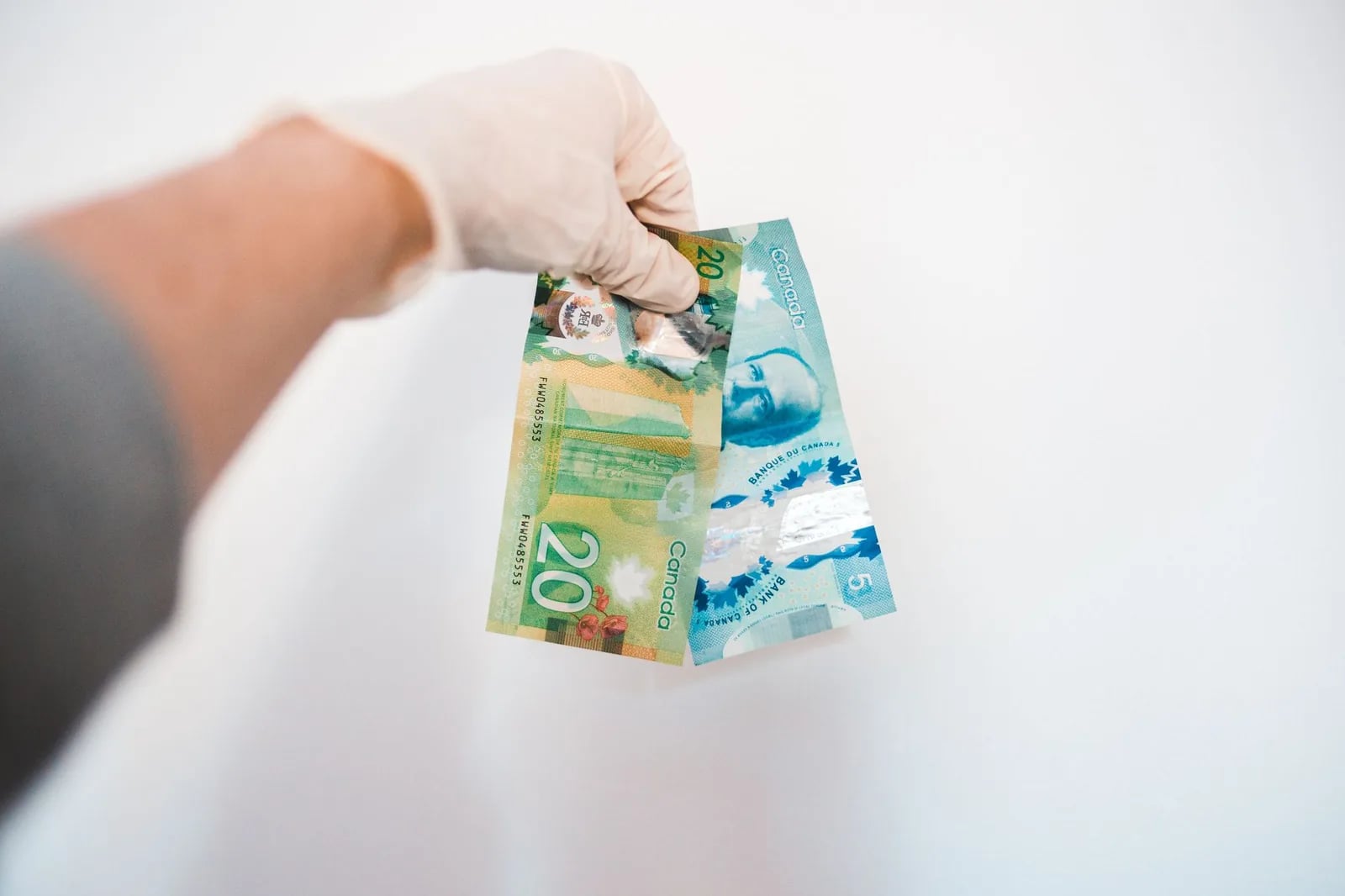
Canada uses polymer banknotes of C$5, C$10, C$20, C$50 and C$100, according to the Bank of Canada. Tourisme Montréal lists coins of 5, 10 and 25 cents, C$1 and C$2.
The C$1 coin is the loonie and the C$2 coin is the toonie. The Royal Canadian Mint introduced the toonie on February 19, 1996 to replace the two-dollar bill. It is a two-metal coin with a bronze center and a lighter ring, easy to spot in a pocket. The 747 airport bus takes exact change in coins, so keep a handful for small purchases.
Why prices end in odd cents but cash totals end in 0 or 5
The one-cent coin is gone. The Mint stopped making the penny in May 2012 and distribution ended in February 2013. The penny is still legal tender, but businesses round cash totals to the nearest five cents, on the whole bill and not item by item. A total of C$31.32 becomes C$31.30 and C$31.33 becomes C$31.35. Card payments are charged to the exact cent, so the rounding only matters if you pay with coins and bills.
Paying by card and contactless in Montreal
Cards are the normal way to pay. Tourisme Montréal says that bank and credit cards, including tap and pay, are welcome almost everywhere, and that Visa, Mastercard and American Express are widely accepted. Terminals ask you to confirm the amount and, in restaurants, the tip.
Two limits are worth knowing. Interac says a single contactless card payment cannot exceed C$250, and your own bank may set a lower cap or ask for the chip and PIN after several taps in a row. Second, some places remain cash only or card only: the Canadian Grand Prix takes cards only on site and has no ATM, while a few market stalls and small counters still prefer cash.
Whether your phone can pay depends on your card issuer, so add your card to your wallet app before you fly. For a trip of a week or less, a good plan is to carry one main card, a backup card from a different network and about C$40 to C$60 in cash for tips and tiny purchases.
Foreign transaction fees, ATMs and currency exchange
The main cost of spending abroad is the foreign transaction fee your card issuer adds to every purchase in Canadian dollars. It varies by card, so read the fee schedule of the card you plan to use. Some travel cards, such as the Chase Sapphire Preferred and the Capital One Venture, say on their own pages that they charge no foreign transaction fees outside the United States. A card without that benefit is better left in the hotel safe.
Pay in Canadian dollars, not in your home currency
When a terminal or an ATM offers to charge you in US dollars, choose Canadian dollars. The offer is called dynamic currency conversion, and the merchant's bank sets the rate, which is often less favorable than your card network's. Declining it is a free saving, and it applies at restaurants, hotels and ATMs alike.
ATMs and exchange offices
ATMs are easy to find downtown, and exchange offices are common around the Old Port and the main shopping streets. Withdrawals can carry two fees, one from the ATM operator and one from your own bank, so take out larger amounts less often. Compare the rate and any commission before you hand cash over to an exchange office. If you land at YUL, our airport guide covers the 747 bus and its exact-change fare.
A multi-currency card can lower the cost if you travel often. Wise says on its US site that its debit card gives free ATM withdrawals up to US$250 a month, then 1.95% plus US$1.95 per withdrawal, and that spending a currency you already hold carries no conversion fee. Revolut's fees depend on your plan and on weekend rates, so check the app before you travel.
Cards and apps to spend Canadian dollars
Compare fees and limits for your plan and country before you rely on either one.
Wise, international money transfers
- Transfers and currency conversion, with fees shown before you send
- Multi-currency account and debit card to pay and withdraw in the local currency
- Check fees, limits and eligibility on the partner's website
Revolut, multi-currency account and card
- App to pay, withdraw and exchange money in several currencies
- Exchange fees and limits vary with the plan you choose
- Check fees, limits and eligibility on the partner's website
Can you use US dollars in Montreal?
Mostly no. Tourisme Montréal states that American dollars are accepted at some stores, but you will need Canadian dollars for most business transactions. A shop that takes US cash picks its own exchange rate, which is rarely generous, and gives change in Canadian dollars.
If you want a few bills for arrival, the simplest way is to pay for your first metro ticket or taxi by card and withdraw Canadian dollars from an ATM once you are downtown.
GST and QST: why the bill is higher than the price
Prices in Quebec are shown before sales tax. Tourisme Montréal explains that the 5% federal GST plus the 9.975% provincial QST are added to most purchases. Together that is 14.975%, so C$100 on a menu or a shelf tag becomes C$114.98 at the register. Some admissions, such as the Space for Life museums, post prices with taxes included, and hotels add a separate 3.5% accommodation tax that we cover in our guide to hotels in Old Montreal.
| Item | Posted price | With taxes |
|---|---|---|
| Schwartz's smoked meat sandwich | C$17.25 | C$19.83 |
| La Banquise classic poutine, regular | C$9.99 | C$11.49 |
| Restaurant bill | C$100.00 | C$114.98 |
Tourists cannot get this tax back on ordinary purchases. The federal visitor rebate program was ended on April 1, 2007, and the programs that remain are narrow, for foreign conventions and some tour packages. For anything unusual, check the rules on the Revenu Québec site before you count on a refund. You will see the tax line on your receipt and it is already included in your card total, so the figure on the terminal is the one you pay.
Tipping in Montreal: how much and when
Tipping is expected in Montreal even though no law requires it. Tourisme Montréal recommends 15% of the bill before taxes for waiters, taxi drivers and hairdressers. Porters and doormen get at least C$2 per suitcase or per service, and housekeeping C$1 to C$2 per day, with about C$10 for a four-night stay considered generous without being excessive.
The tip is calculated before taxes
According to Éducaloi, Quebec's legal information organization, businesses that suggest a tip have had to calculate it on the amount before taxes since May 7, 2025. They must also offer a custom amount or a no-tip option. Terminals often show 15%, 18% and 20%, so on a C$100 bill before tax the suggestions are C$15, C$18 and C$20, not figures inflated by the 14.975% tax. If your server brings a handheld terminal, check that the percentages apply to the subtotal.
For a meal of C$27.24 before taxes, a 15% tip is about C$4.09. At counters and coffee shops a tip is optional, and most visitors leave a toonie or use the terminal option when someone makes a drink for them. Guided food tours often add a tip on top of the ticket, and our Montreal restaurant guide notes the places that add a service charge automatically for large groups.
Daily budget in Montreal in Canadian and US dollars
Here is a simple day without a hotel, made only of prices published on this site and already taxed: a 24-hour transit pass, a poutine, a smoked meat sandwich and the Biodome. It shows how the taxes and the exchange rate change the numbers you see on a menu.
| Item | In C$ | In US$ |
|---|---|---|
| 24-hour transit pass | C$11.25 | US$7.85 |
| Classic poutine, taxes included | C$11.49 | US$8.02 |
| Smoked meat sandwich, taxes included | C$19.83 | US$13.84 |
| Biodome adult ticket | C$25.50 | US$17.80 |
| Total before tip | C$68.07 | About US$47.50 |
Add about C$4 if you tip at a sit-down restaurant, which puts the day near C$72. It will rise with a museum such as the MBAM, which charges C$32 for an adult with the major exhibition, or with a dinner at a place such as Le Square, where the bavette is C$38 before tax. Hotels are the largest cost and vary a lot by season, so see our Montreal hotel guide and build the total from there.